
Growth efficiency, conversion and customer journey improvement · 9 August 2026
Before You Add Another Growth Channel, Improve the Engine You Already Have
Before adding more traffic, campaigns or spend, look at what happens to the customers already entering your journey. Small improvements can change the economics of everything you scale next.
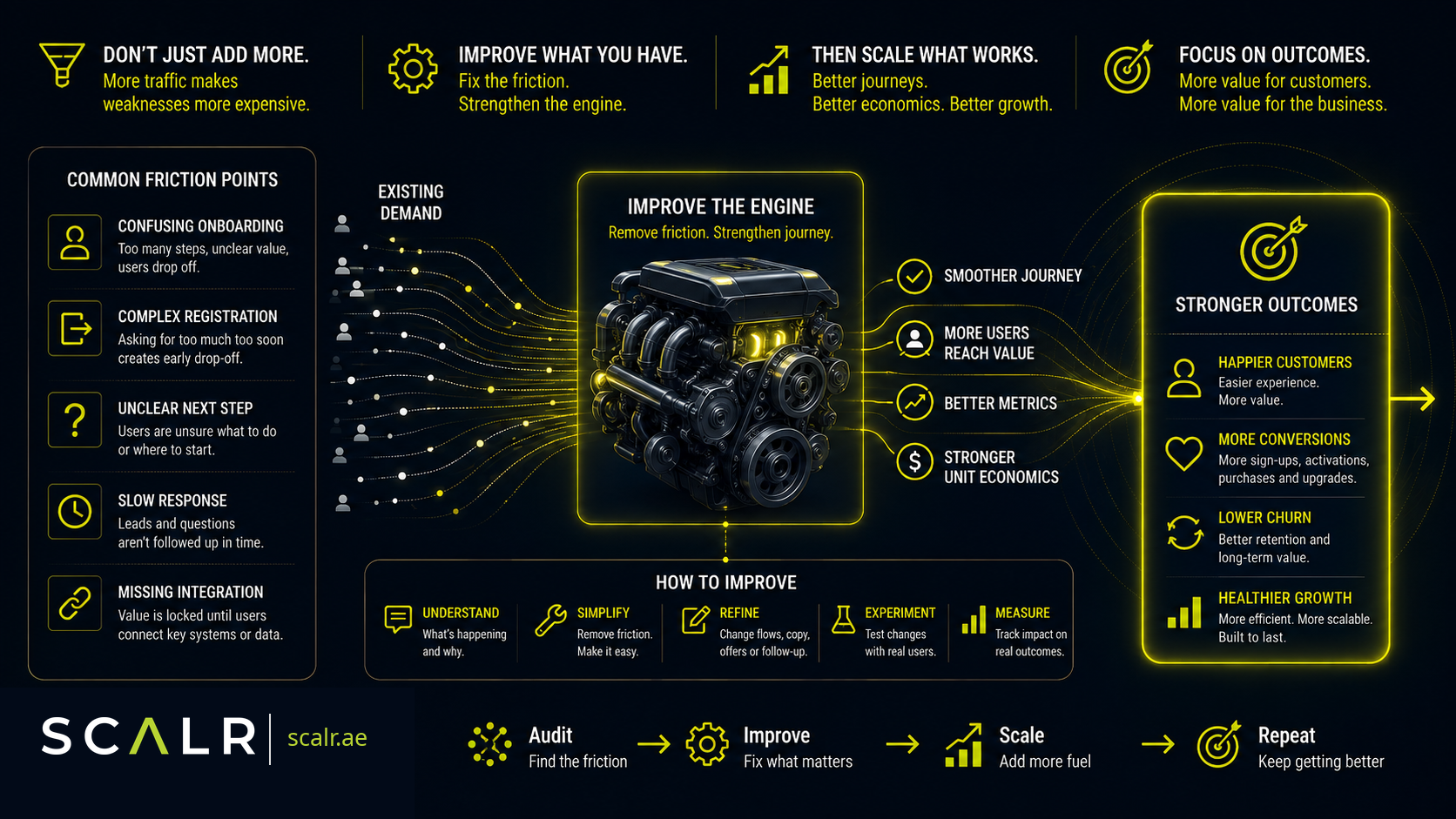
There is a point in many startups where the conversation naturally turns to the next source of growth. Should we try TikTok, spend more on Google, start outbound, build partnerships, hire a performance marketer or bring in an agency? Maybe.
But before adding another source of demand, I like to look at what is happening with the demand the company already has. Quite often, there is more growth sitting inside the existing customer journey than it first appears.
Start with the customers already coming through the door
Imagine an EdTech startup bringing 10,000 people to its website each month. A thousand start registration, 400 finish it, 100 actually begin a course and 20 become paying customers. The instinct might be: We need more traffic. And eventually, they probably do.
But before paying for the next 10,000 visitors, I'd want to understand what happened to the first 10,000. Why did so few start registration? Why did 600 abandon it? Why did 300 people register but never start learning? And what was different about the 20 who eventually paid?
You might discover that registration asks for too much information too early. Perhaps people register but aren't sure which course to start, or the first lesson requires another setup step that nobody explained. Improve one of those things and every existing and future acquisition channel starts working a little harder. That's why I prefer to improve before adding more fuel.
Scaling also scales the friction
This doesn't mean waiting until everything is perfect before growing. Nothing will ever be perfect. It means identifying the parts of the current setup that become more expensive when you multiply them.
If onboarding is confusing, doubling acquisition gives you twice as many confused users. If sales takes two days to respond to a good property lead, buying more leads doesn't fix the response time. If customers sign up for your AI product but never connect it to the systems where it becomes genuinely useful, another campaign gives you more inactive accounts.
And if customers love the product and keep returning, but nobody has built a simple way to encourage referrals, upgrades or repeat purchases, there may be easier growth sitting in the existing customer base.
None of this means the original setup was wrong. Often these opportunities only become visible because the company has grown. You finally have enough customers, behaviour and data to see patterns that weren't visible when there were only 100 users. That's a normal part of scaling.
The setup that got you here did its job. Now you can make it better for where you're going next.
Find the improvement that changes the outcome
I wouldn't try to optimise the entire funnel at once. Look for the part of the customer journey where a meaningful improvement would have the biggest effect.
For a FinTech app, perhaps plenty of people register but too few make their first transaction. For a PropTech platform, enquiry volume may be healthy but too few enquiries turn into qualified conversations. For an AI startup, plenty of people might try the product, but the real value only appears once they connect it to their website, CRM, WhatsApp or customer data.
That's where I'd focus. Understand what is getting in the way, improve the flow, change the message, remove unnecessary friction and follow up differently. Then measure whether it actually changed the outcome.
If it did, something important has happened. You're no longer discussing another growth idea. You have a better-performing growth engine.
Then add more fuel
This is when the next acquisition channel becomes much more interesting. Every new customer now enters a stronger journey. More people reach value, the economics improve, and you understand more about which customers you're trying to attract and what needs to happen after they arrive. You have something that is actually worth scaling.
So yes, test TikTok. Increase the budget. Build partnerships. Hire the marketer. Just ask one question first: If we doubled the number of customers entering our current journey tomorrow, would we be happy with what happens to them?
If the answer is no, that's probably where I'd start.
Improve what you have. Prove it works. Then scale it.