
Startup operating models, systems and scaling · 10 August 2026
The Business Scaled. The Operating Model Needs to Scale Next.
The ways of working that created early speed often need to evolve as the company grows. The goal is not more process, but enough structure to keep moving fast as complexity increases.
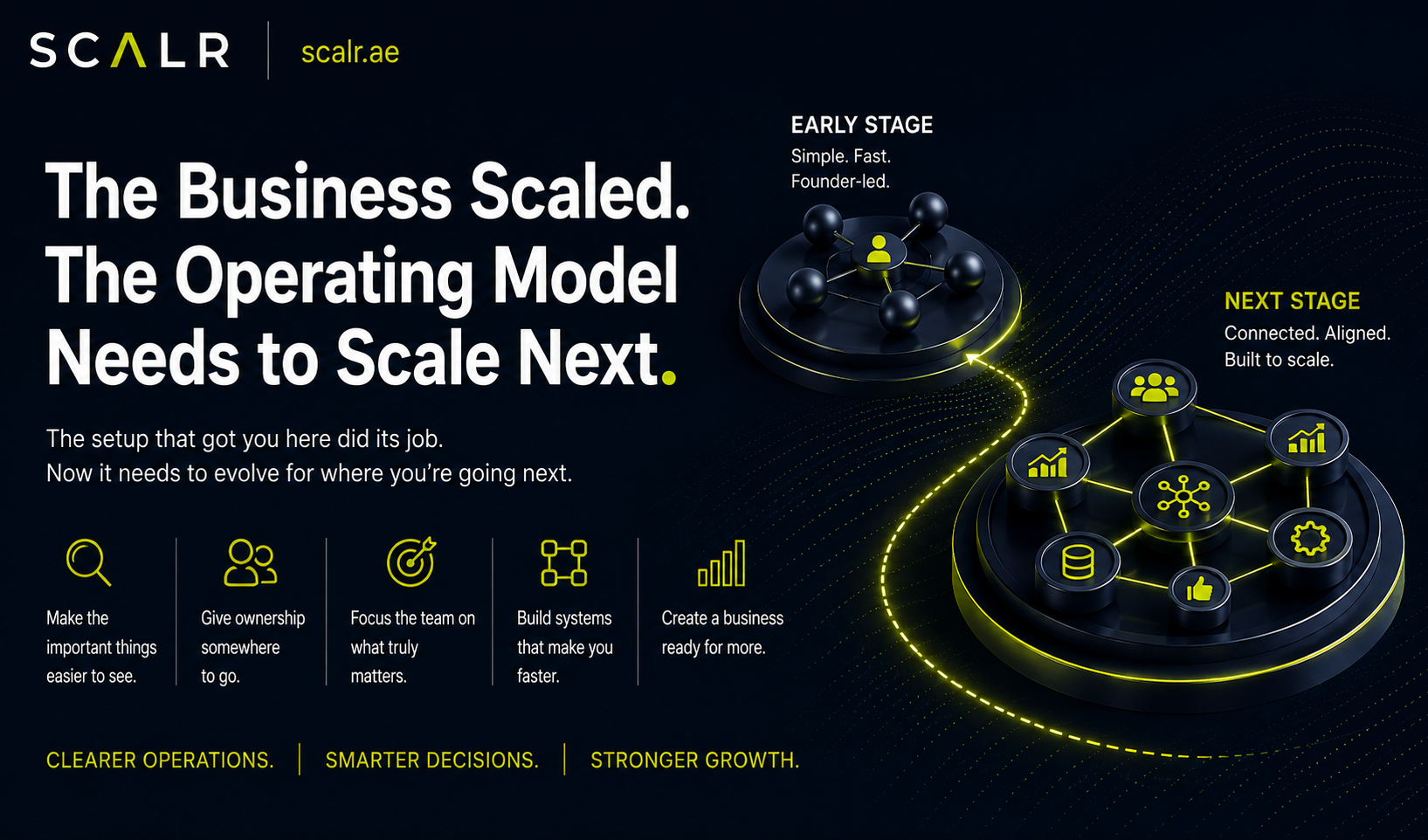
A lot of startups begin with a surprisingly simple operating model. The founder knows what customers want, the team sits close together, and decisions happen quickly because the people making them are usually involved in the work themselves. Someone knows which campaigns are working, someone else knows why a customer hasn't converted, and the founder can still connect most of the dots.
A spreadsheet can be enough. A few Slack or WhatsApp messages can keep everyone aligned. For that stage of the company, that's often exactly what you need.
Then the business grows. There are more customers, people, markets, campaigns, tools, data and decisions. The company has moved forward, and the way it operates needs to move forward with it.
What worked with five people gets harder with twenty
This change rarely happens overnight. It starts with small things. Marketing has one version of the customer numbers while sales has another. Someone exports data from the CRM every Monday because the dashboard doesn't quite show what the team needs. The founder gets pulled into decisions that should no longer require founder involvement.
A campaign is launched, but nobody is completely sure who owns the follow-up. A customer issue gets discussed in WhatsApp while the information needed to solve it sits somewhere else. One person becomes the unofficial connection between several teams because they know where everything is.
None of these necessarily means something is wrong. Usually, they mean the company has become more complex than the operating setup it started with. That's progress, but it is also a signal that the next stage needs a different setup.
Don't start by buying more software
When this happens, adding another tool can feel like the obvious answer. Sometimes it is. But I'd start somewhere else: look at how the business actually works today.
Where does information come from and where does it go? Which decisions happen repeatedly, who makes them, and what information do they need? Most importantly, where are people manually connecting systems, teams or data because the process doesn't do it for them?
That last question is particularly useful. If someone is constantly exporting, copying, checking, reminding, reconciling or explaining, they're often showing you where the operating model needs to evolve.
Make the important things easier to see
As a company grows, the founder shouldn't need to know every detail. But the important things should become more visible, not less. You should be able to see whether acquisition is improving, customers are reaching value, good leads are being followed up, customers are returning, a new market is actually working, and whether the team is spending time on the things that matter.
This doesn't require 40 dashboards. Often it means agreeing on a relatively small number of numbers that everyone trusts, deciding who owns them, and making them easy to see.
Then meetings change too. Instead of spending most of the time asking, “What happened?”, the team can spend more time on, “Why did it happen, and what are we doing next?” That's a much better use of a growing team's time.
Give ownership somewhere to go
The same applies to decisions. In an early startup, founder involvement is often a strength because the founder carries context that nobody else has yet. As the business grows, some of that context needs to move into the company through clear goals, clear ownership, shared customer information, agreed definitions and simple processes for recurring decisions.
Not because the company needs more bureaucracy. Quite the opposite. The aim is to let more decisions happen without waiting for the founder, giving the founder more time for the decisions where founder involvement really does matter.
Keep what made the company fast
Scaling the operating model doesn't mean turning a startup into a large corporation. You don't need a process for everything, another meeting because something happened twice, or to replace every tool that got the company this far.
Keep what still works. Improve what is becoming difficult. Automate what is repetitive. Connect what has become fragmented. Clarify what has become ambiguous. Add structure where it makes the company faster, not slower.
The goal isn't a more complicated business. It's a business that can handle more complexity without feeling more complicated.
Build for the company you're becoming
There isn't one moment when a startup suddenly needs an “operating model.” It evolves. The systems, data and ways of working that helped you reach the first stage shouldn't automatically be expected to carry you through the next one. That's normal. Growth changes what the business needs.
So when things start feeling harder to coordinate, don't immediately assume you need more people, more software or more meetings. First ask:
Has the way we operate caught up with the company we've become?
If not, that's the next thing to scale.