
Data, measurement and growth decision-making · 8 August 2026
You Have the Dashboard. Do You Know What’s Driving Growth?
More data does not automatically mean better decisions. Start by making sure you can trust what you track, then understand what actually moves the business.
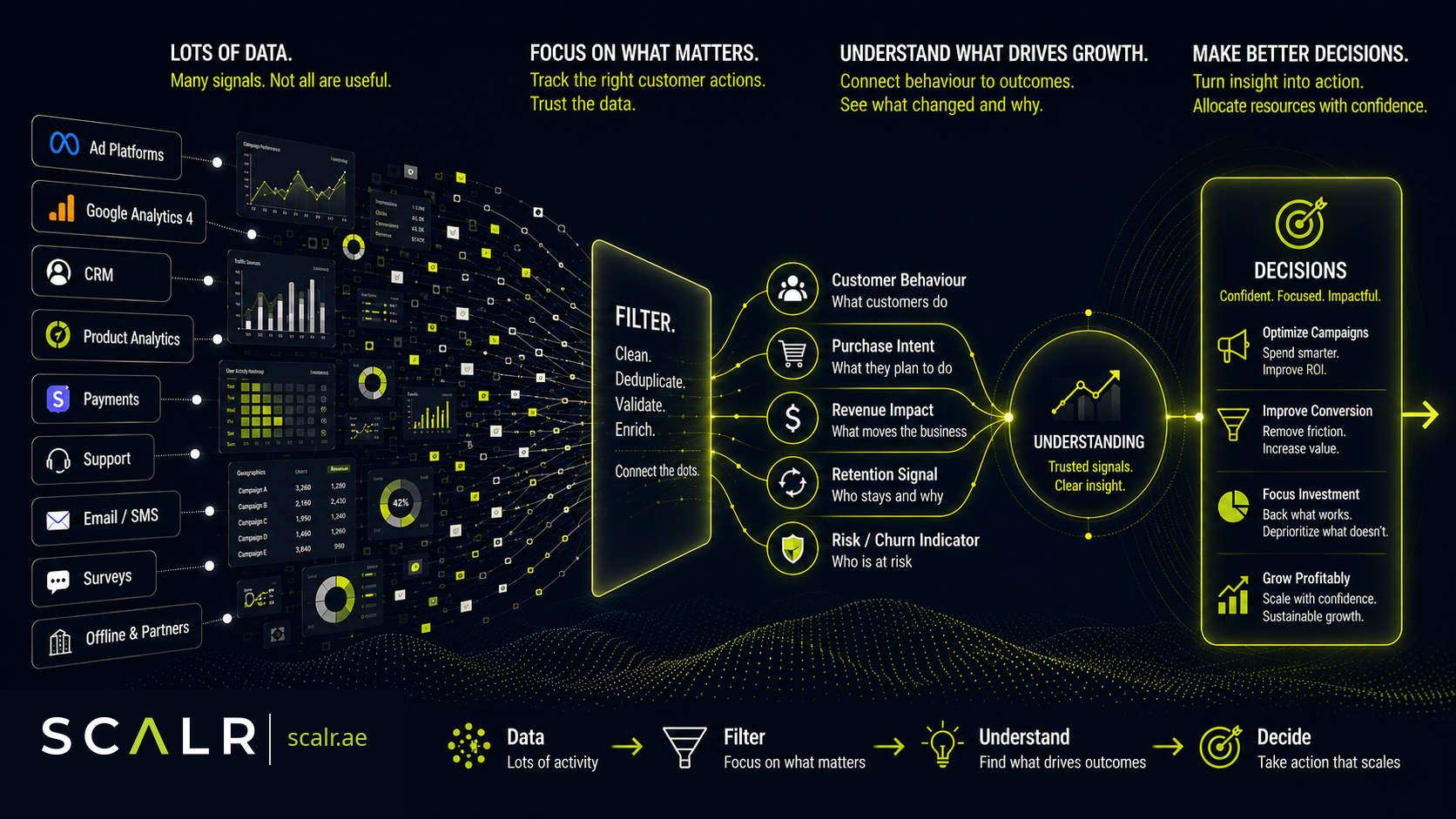
Most startups I speak to aren't short of data. GA4 is running, Meta and Google have dashboards, the CRM has reports, Stripe knows the revenue, and the product team may have Mixpanel, Amplitude or another analytics tool. There are numbers everywhere.
But ask a slightly different question: What is actually driving growth right now? That can be surprisingly difficult to answer.
A dashboard might show that leads increased 30% last month. Great. But why? Did the new campaign work, did organic traffic increase, did a partnership start performing, did more people search for the brand after seeing it somewhere else, or did somebody change the tracking?
These aren't analytics questions for the sake of analytics. The answers determine what you do with the next dirham.
First, can you trust the numbers?
Before trying to understand what is driving growth, make sure the tracking itself is giving you a reliable picture. This sounds obvious, but in practice it is an easy place to get false confidence.
A campaign can suddenly look stronger because attribution changed. A conversion can disappear because an event stopped firing. The CRM and advertising platform can report very different numbers for what appears to be the same outcome. And sometimes the tracking is technically correct but still not particularly useful.
Take an AI chatbot startup. Tracking account registrations is easy, but registration doesn't tell you whether somebody got any value from the product. Perhaps the important moment is when they connect WhatsApp, upload their knowledge base or put the chatbot live on their website. Maybe the strongest predictor of becoming a paying customer is receiving the first ten real customer conversations through it. That is the behaviour worth understanding.
The same distinction exists elsewhere. For a FinTech app, registration isn't the same as funding an account or making the first transaction. For an EdTech platform, signing up isn't the same as starting the first lesson. For a PropTech platform, a lead isn't necessarily a qualified conversation.
You don't need to track everything because you can. You need to track the actions that tell you whether customers are moving towards value. And while GA4, your CRM, payment platform and product analytics will rarely match perfectly, they should tell a story you can explain. If one says you acquired 800 customers and another says 500, understand the difference before making a budget decision from either.
Then ask what actually caused the result
Imagine you're running a PropTech startup. Google Ads reports a great month, cost per lead is down and conversions are up. The obvious conclusion is to increase the budget.
But dig deeper and you might discover that most of the improvement came from branded searches. More people already knew the company and Google Ads caught them near the end of their journey. The campaign may still be valuable, but it didn't necessarily create all that demand. That's a very different growth story.
Or perhaps an EdTech company sees that one partnership produces fewer registrations than paid social, but those students are twice as likely to start learning and remain subscribed. Which channel is really performing better? The answer depends on where you stop measuring.
Follow the customer, not the dashboard
This is why I prefer to look at the customer journey across the business rather than treating marketing, product, sales and revenue as separate sets of numbers. Where did the customer come from? What made them take the first step? Did they reach the point where the product became useful? Did they pay, return or buy more?
You don't need 40 KPIs to start seeing the picture. You need enough reliable information to understand where customers are moving, where they stop, and which customers ultimately create value.
There is a simple test you can run with the dashboard you already have. Take the five numbers you look at most often and ask: If this number changes significantly next week, what decision will we make differently?
If nobody knows, question why you're watching it. Then ask: What do we wish we knew but currently can't answer?
That second question may tell you more about what your analytics setup needs next than another dashboard ever will.
Because having data isn't the goal. Knowing what to do next is.