
AI software / PropTech · 16 August 2026
From Product Build to Market Ready: Preparing a Technology Company for Growth
How Jens, Founder of SCALR, worked as an embedded growth partner with an early-stage AI software company, connecting product decisions, customer understanding, pricing, measurement and go-to-market foundations before launch.
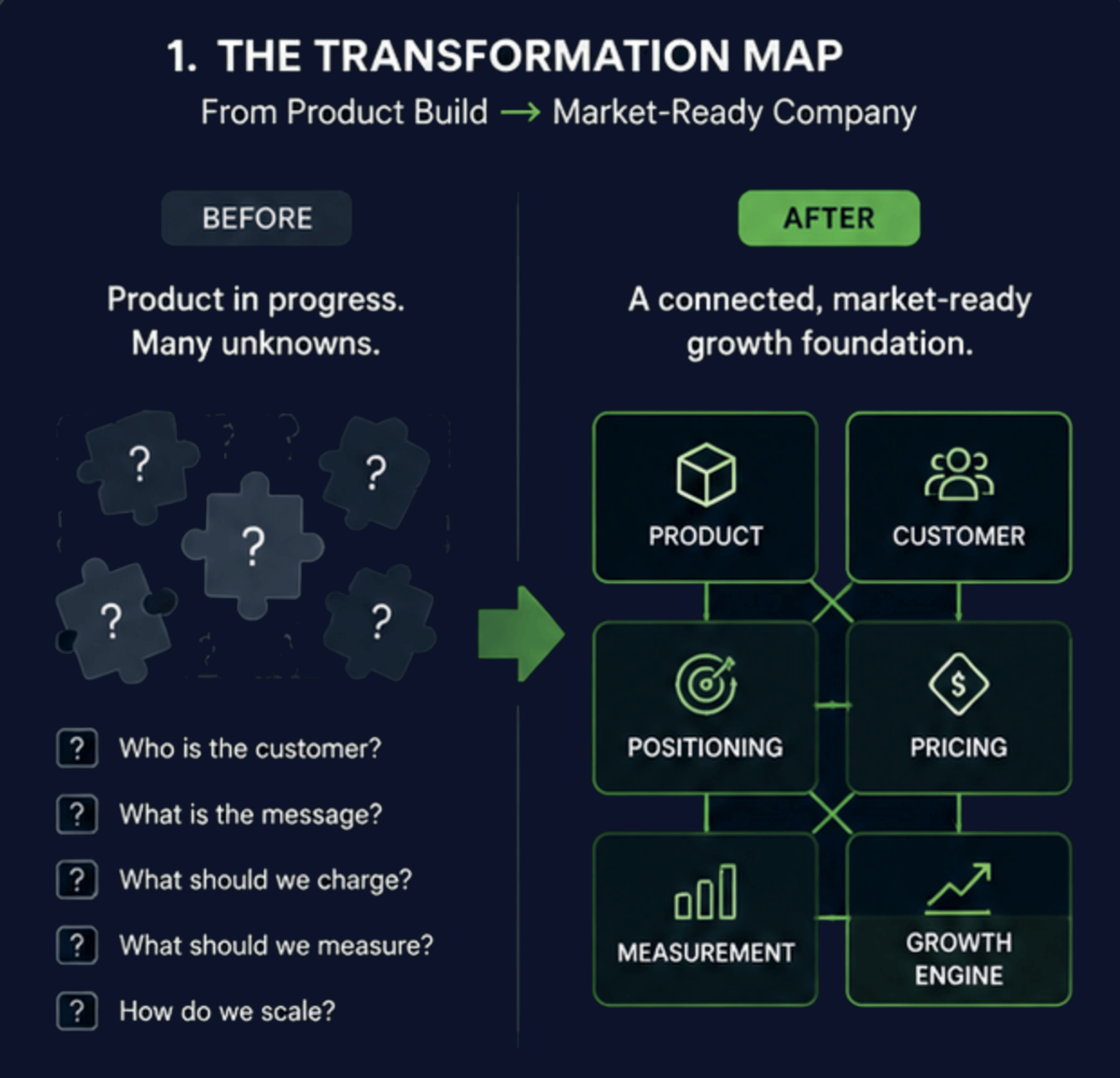
Building a technology product is only the first step. For early-stage founders, the difficult decisions often begin before the first major growth phase. The product may already work, the technology may be strong and the team may have a clear vision. Turning that vision into a product customers understand, trust and are willing to adopt requires the product, customer, commercial and growth decisions to connect.
Eight questions that shaped the launch preparation
Before thinking about scale, the team needed clear answers to eight connected questions:
- Who exactly is the product for? Define the customers most likely to benefit.
- Which customer problem should be prioritised? Focus the product on meaningful value.
- How should that value be explained? Translate technical capability into a clear customer story.
- Which features matter most at launch? Separate essential journeys from ideas that can wait.
- What should customers experience before being asked to subscribe? Connect product value with the commercial model.
- Which behaviours indicate real value? Identify the actions and milestones that matter.
- What data needs to be captured from day one? Build measurement into the product and customer journey.
- How will the company keep improving? Establish a repeatable learning and experimentation rhythm.
To help answer them, Jens Behnisch, Founder of SCALR, joined the company as an embedded growth partner for three months. He worked directly with the founder, product team and developers, moving between strategic decisions and the practical work required to prepare for launch. This was not a stand-back advisory role. Jens joined the conversations in which priorities were set, assumptions were challenged and product, customer and commercial choices were translated into action.
The company is not named here, so the focus stays on the work itself: how embedded growth leadership helped move the team from a strong product idea and many open questions towards a connected, market-ready growth foundation.
The starting point: a strong product, but many open decisions
The company had built a promising AI software product and was preparing for market entry. The challenge was not simply generating awareness. Before meaningful acquisition activity could begin, the team needed confidence that every part of the business pointed in the same direction.
The founder had the vision. The product and development teams were building the technical capability. An external agency was supporting the website. But important decisions still crossed the boundaries between those workstreams: which users would benefit most, which features deserved priority, how the value should be explained, what the company should charge and what data would be needed after launch. A decision about positioning, pricing or measurement could affect the website, product journey and development priorities.
Jens's mandate was to help the founder and team connect those decisions while the product was still taking shape. Rather than delivering a strategy document and leaving implementation to others, he became part of the working rhythm of the company and helped move decisions forward across product, customer, commercial and go-to-market work.
Working as an embedded extension of the founder and product team
The engagement was designed around close, recurring collaboration. Jens worked with the founder on priorities and trade-offs: where limited resources could create the greatest customer value, which assumptions required validation, what needed to be ready for launch and which activities should deliberately wait. Together they developed a structured opportunity backlog and a "not-to-do list" that protected time and development capacity.
Because Jens stayed close to execution, founder decisions could be discussed with the product team, technical constraints could shape customer communication and insights from prospective users could change priorities. Website, pricing, tracking and launch planning progressed in parallel rather than being passed between teams in sequence.
The goal was not to create more plans. The goal was to create better decisions and help the team act on them.
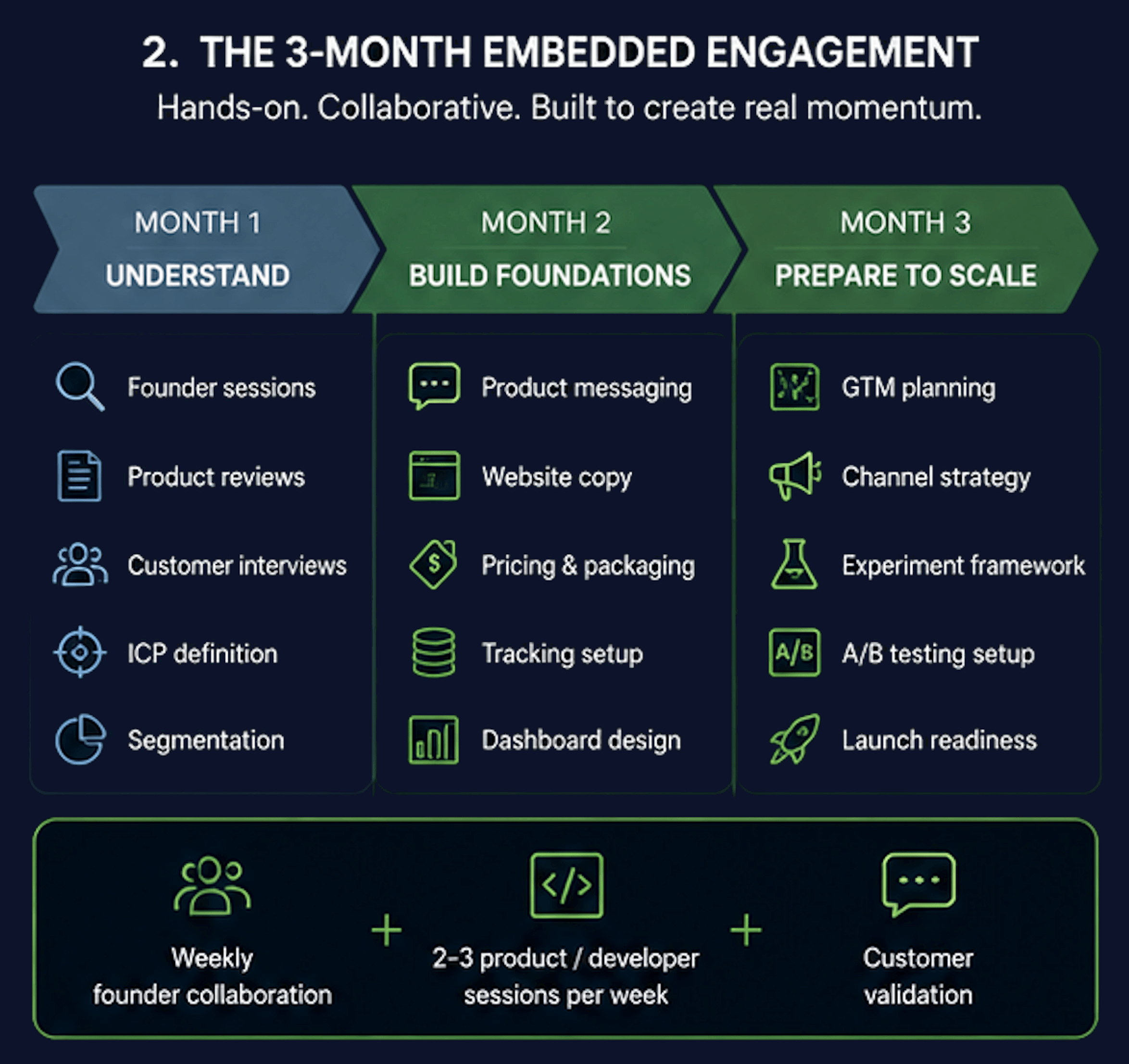
The three-month rhythm combined weekly founder collaboration, two to three product and developer working sessions per week, customer validation and launch preparation. The cadence gave Jens enough proximity to understand the reasoning behind decisions, while keeping the work focused on what the company actually needed next.
Connecting technical capability with customer value
One of the most important parts of the engagement happened inside the product-development process. Jens joined detailed technical discussions with developers multiple times per week, often in working sessions lasting up to two hours. His role was not to manage engineering. It was to connect technical choices with the customer outcome the product needed to create.
A recurring question guided the work:
How does this technical capability become something a customer understands and values?
Jens and the team reviewed product features, user workflows, customer journeys, feature explanations, onboarding considerations and the communication of value. By participating before the product was complete, he could help translate capability into clarity while decisions were still flexible. That was especially important for an AI product: the team needed a clear connection between sophisticated technical capability, the problem it addressed and the value a customer could recognise.
Understanding customers before scaling
Before investing heavily in acquisition, the company needed a stronger view of who the product was really for. Jens worked with the founder to develop the ideal customer profile and segmentation approach, identifying plausible customer groups, the needs that distinguished them, where they might be reached and which messages would be relevant to each segment.
This work was not completed only in internal workshops. Jens also spoke with prospective users to understand how they described their challenges, what they expected from a solution, which product concepts felt immediately valuable and where the explanation created hesitation or confusion.
Those conversations gave the founder and team another way to evaluate assumptions. Customer language informed positioning and website copy, reactions to product concepts supported launch-priority discussions, and differences between customer groups shaped segmentation and the initial go-to-market plan. Customer understanding did not remain in a research document; it flowed into decisions elsewhere.
Turning capability into a clear market message
Technology companies often struggle to explain value because internal expertise and customer understanding start from different places. The product team knows how the technology works. A potential customer needs to know what it will help them do, why that matters and why they should trust it.
Jens worked across product positioning, naming discussions, website structure, approved website copy, customer-facing explanations, FAQ content and help content. The objective was not to remove useful complexity from the product. It was to remove unnecessary confusion from the way the value was communicated.
The company was also working with an external website agency. Connecting the founder's intent, product reality, customer needs and website execution, Jens helped ensure that the site communicated one coherent customer story rather than disconnected feature descriptions.
The website needed to answer four questions quickly:
- What is this?
- Who is it for?
- Why does it matter?
- What should I do next?
Answering those questions depended on the ICP work, product priorities and customer conversations happening alongside the website. For an early-stage company, the site is often the first place where the product, positioning and commercial proposition have to make sense together.
Building the commercial foundation before launch
A strong product needs more than adoption. It needs a credible path from customer value to commercial sustainability. Jens therefore worked with the founder on pricing and packaging before launch, while there was still time to connect the commercial model with the product experience.
The work covered the core offer, plan structure, upgrade paths and the point at which a user should move from experiencing value to becoming a paying customer. The objective was not simply to select a price, but to connect what was packaged with customer needs and the value already demonstrated.
How does the customer first understand the value, and how does that naturally lead into a commercial relationship?
That question linked pricing back to the product journey, positioning, segmentation and measurement. By treating pricing as part of the growth foundation rather than a separate finance exercise, Jens helped the founder connect product access, perceived value, packaging and future paid adoption.
Creating the go-to-market foundation
As the customer profile and positioning became clearer, Jens worked with the founder on how the company could begin reaching potential customers. The work included target audiences, segmentation, channel opportunities, campaign structure, acquisition planning, initial budget considerations and possible partnership routes.
The company needed a focused starting point that matched its stage and resources: which audiences were the most credible priorities to test, which channels could reach them, what they needed to hear and how acquisition would connect to product value.
Potential partnerships were considered in the same practical way. Instead of a generic list, Jens and the team examined which relationships could be relevant, what mutual value they might create and how an approach could be structured. The result was a go-to-market foundation, not a promise of immediate scale, with clearer choices about where to focus and what the company needed to learn.
Building measurement before growth
Many companies begin acquisition activity and add measurement later. Jens brought measurement into the launch preparation because marketing activity without behavioural understanding would make it harder for the team to learn from its first users.
Working with the founder, product team and developers, he designed the tracking foundation for the customer journey. This included website requirements, product and application events, event naming conventions, definitions of meaningful actions and the relationship between behaviour and future communication.
The key question was not "What data can we collect?" It was:
What decisions should this data help us make?
That reframed tracking as an operating tool rather than a technical checklist. The team considered which actions suggested value, which behaviours indicated stronger engagement, where people might disengage and what signals should lead to a relevant response.
A five-step measurement and decision loop
- Capture the customer action. Record what happened and what was completed.
- Identify a meaningful milestone. Decide whether the action signals real progress.
- Understand the customer state. Combine behaviours to create a more useful picture.
- Choose the next action. Connect the signal with relevant communication or product follow-up.
- Learn through the dashboard. See what matters and decide what to improve next.
A single action rarely tells the complete story. A user completing several meaningful steps may represent a stronger signal than completing only one. By defining the logic before launch, Jens helped the team create the basis for learning from behaviour rather than relying only on assumptions or isolated metrics.
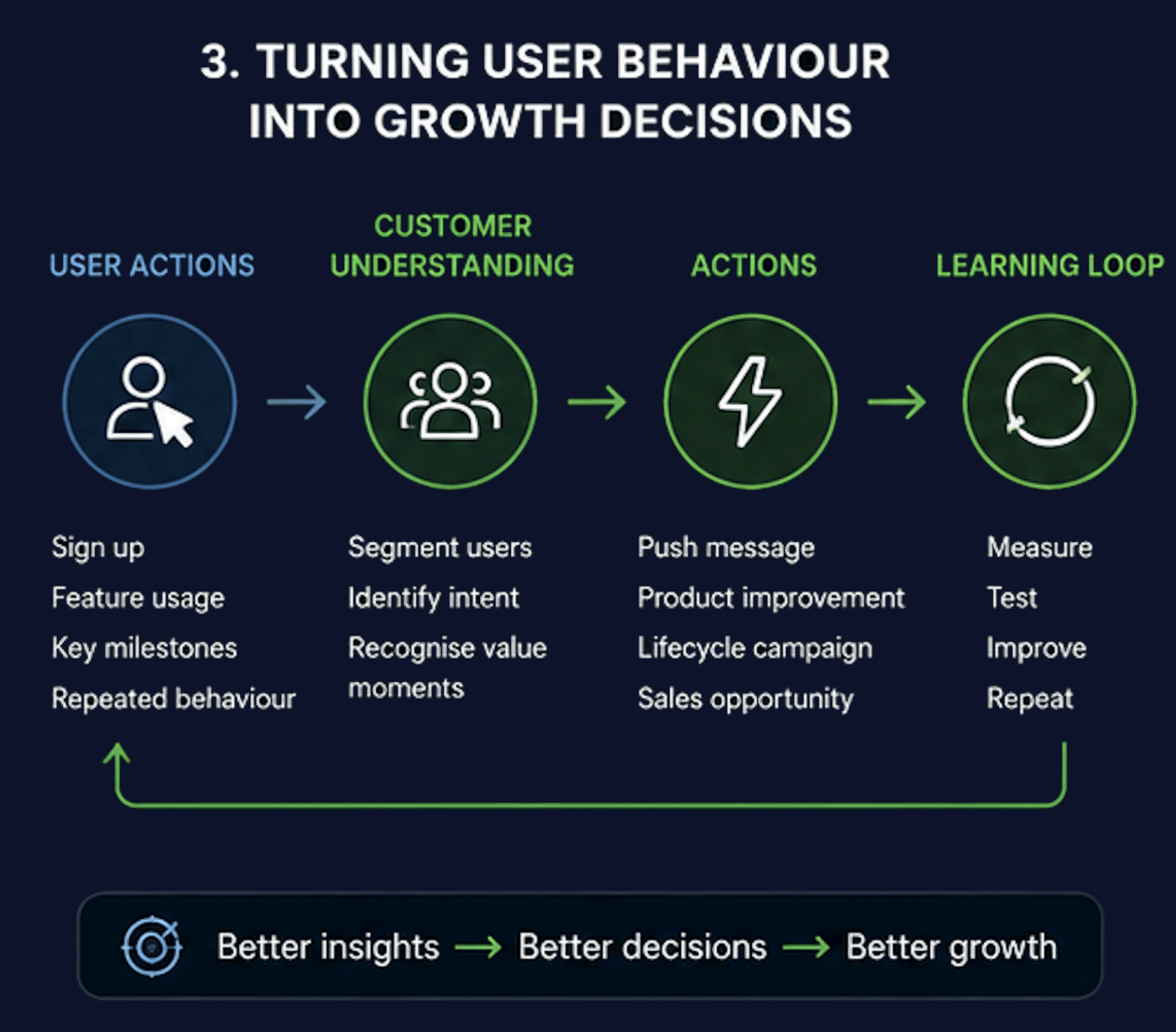
Turning data into decisions through KPI dashboards
Tracking alone does not create better decisions. The team also needed a way to interpret what the data meant. Jens worked on the KPI dashboard structure: which measures mattered, how they should be visualised, what question each metric should answer and where reporting could become more automated over time.
The objective was not to fill dashboards with numbers. It was to reveal whether the intended users were discovering the product, reaching meaningful moments of value or disengaging, and where the team should investigate next. Data was intended to improve conversations between the founder, product team and growth partner about priorities, product changes and future experiments. The first dashboard did not need to measure everything; it needed to make the most important questions visible.
Creating a continuous improvement engine
The final workstream prepared the company to continue learning after launch. Jens helped establish an experimentation approach that connected product improvements, messaging, user communication and marketing activity.
The system included an experiment backlog, prioritisation logic, an A/B testing structure, evaluation criteria and a recurring test-and-learn rhythm. Because it grew from the same customer, product and measurement foundations, experiments could be linked to genuine questions rather than isolated campaign ideas.
The principle was simple: do not rely on opinions when the company can learn from customers. Product teams can test features and user flows; growth teams can test messages and channels; lifecycle work can test communication and timing. Throughout the engagement, Jens helped the team move from assumptions to priorities, from priorities to execution and from evidence back into decisions. That operating rhythm was as important as any individual deliverable.
The six foundations prepared before launch
The outcome was not a single campaign or a claim of post-launch performance. It was documented launch readiness across six connected areas:
- Product and customer value. Technical capability was connected with clearer customer outcomes, essential journeys and launch priorities.
- Customer understanding and ICP. Segments, needs and conversations with prospective users informed the team's decisions.
- Positioning and messaging. Product capability became a more coherent customer story across the website, product explanations and support content.
- Pricing and packaging. The founder had an initial commercial structure linking product value, plans and potential upgrade paths.
- Measurement and dashboards. Events, milestones and KPI logic created the basis for understanding behaviour and making evidence-led decisions.
- Go-to-market foundation. Priority audiences, channels, campaign thinking and partnership opportunities formed a focused starting plan.
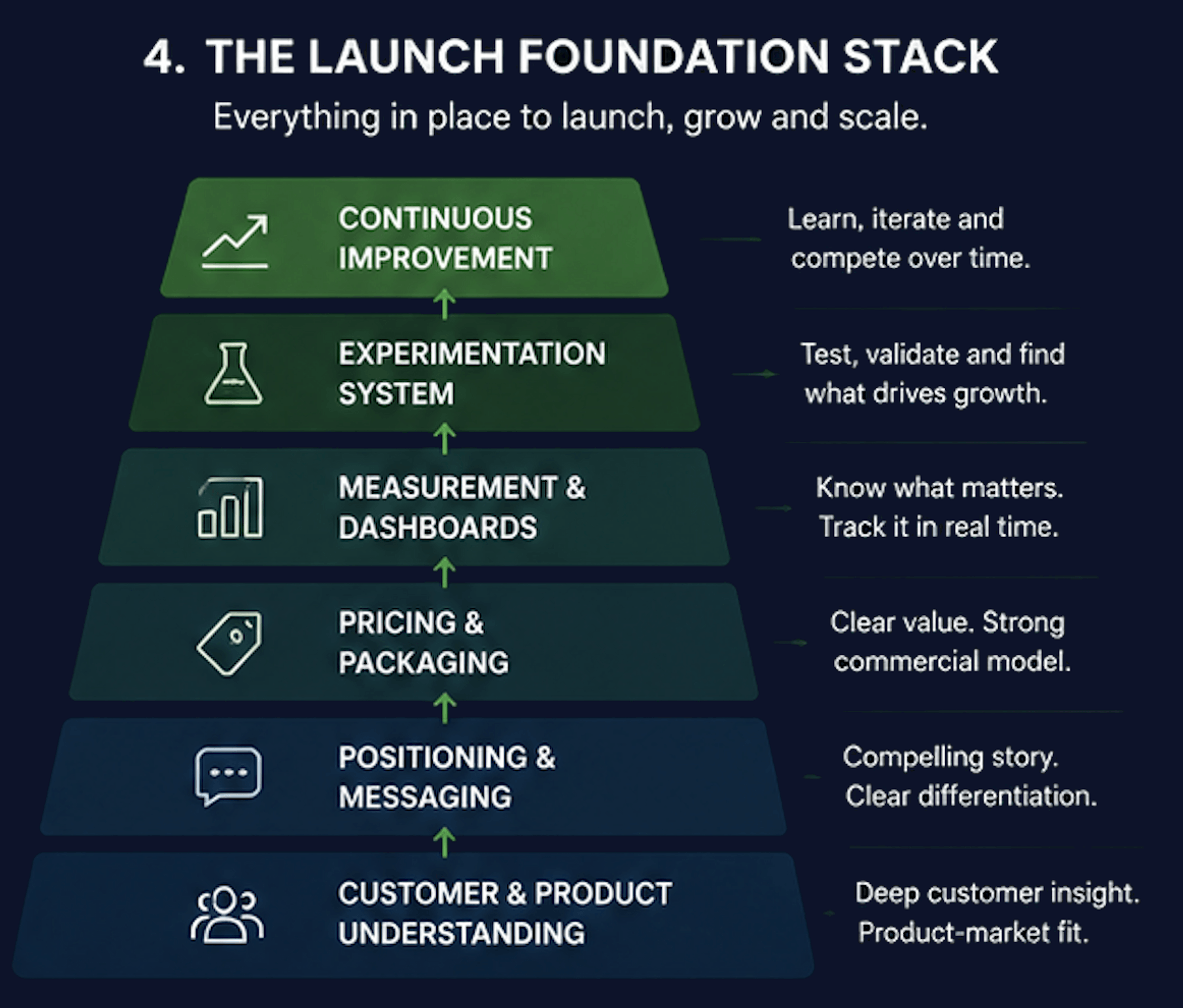
By the end of the three months, the founder was not left with one presentation or disconnected recommendations. The company had more coherent launch priorities, customer and positioning decisions, commercial logic, measurement requirements, go-to-market choices and processes for continued learning.
That is the practical difference an embedded growth partner can make. Jens worked across the boundaries between founder vision and product reality, technical capability and customer value, strategy and execution, and marketing activity and measurable behaviour. The company was better prepared because those decisions had been considered together.
Four lessons for founders
- Growth starts before marketing. The foundation for growth is created through product decisions, customer understanding, positioning and the commercial model. Marketing cannot compensate for unclear value.
- An embedded partner can connect decisions that sit between teams. Product, website, pricing, customer research and measurement affect one another. Working inside the company rhythm makes those dependencies easier to resolve.
- Data is valuable when it changes decisions. Tracking every action is not the goal. The goal is understanding which actions matter, what they reveal and what the team should do next.
- Early-stage companies need focus more than more ideas. There will always be more opportunities than available resources. The ability to prioritise, defer and learn is a competitive advantage.
For founders preparing to move from product development into the market, this is the work SCALR supports: Jens joins the team as an embedded growth partner, helps connect the decisions around the product and builds the practical foundation required for the next stage.