
Buying decision, category and embedded growth · 4 September 2026
Agency, fractional CMO or embedded growth partner: which one fits right now?
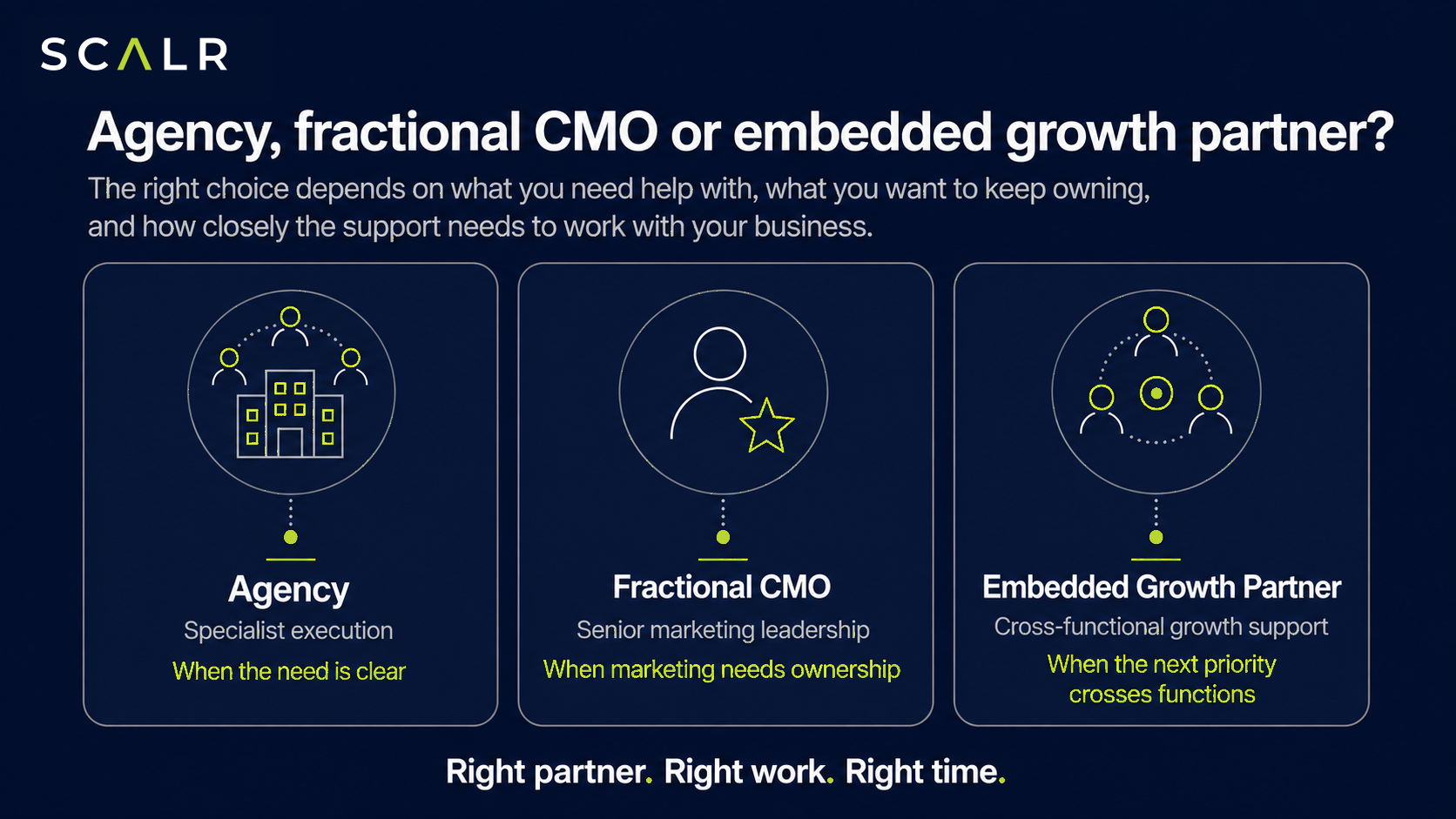
An agency gives you specialist execution. A fractional CMO gives you senior marketing leadership. An embedded growth partner works across the parts of the business affecting growth. The right choice depends on what needs to happen next.
By Jens Behnisch
Choosing outside growth support is not really a question of job titles.
The first question is simpler: what do you actually need help with?
Maybe growth has slowed. Marketing needs more structure. A channel needs specialist help. Too many decisions still sit with the founder. Or several parts of the business need to move together.
The question is not which model is best. It is which kind of support fits the work that needs to be done now. All three can be the right answer, but they start from different places, need different levels of direction, and leave different responsibilities inside the company.
Three different ways to bring in support
You can hire an agency, bring in a fractional CMO, or work with someone embedded in the business. All three can add real value. What changes is the working relationship: who decides what matters, who turns the business problem into a brief, who connects the work back to customers, product and commercial goals, and who notices when the original priority is no longer the right one?
Bringing in support does not automatically remove work from the founder or founding team. Depending on the model, it can give you more specialist capacity, more senior leadership, or someone who takes on more of the thinking and coordination across the business.
It is not only about what they can do. It is also about what you still need to do once they are there.
Agency: specialist capability and more execution capacity
An agency can be a great choice when you already know what you need.
You may want paid search, SEO, content, PR, creative, performance marketing or another specialist capability. You agree on the work, and the agency gives you access to people who spend their time getting very good at that particular thing.
That specialist depth is one of the biggest advantages. You do not need to hire every capability yourself, and you can bring in experienced people much faster than building a full internal team.
For a company with clear priorities and someone internally who owns the direction, this can work extremely well.
The internal owner still matters because someone needs to decide what the agency should focus on, provide enough business context, answer questions, review the work and connect what the agency is doing to the rest of the company.
The agency gives you capability, but it does not necessarily take ownership of the bigger growth question. That distinction matters when you are still deciding what deserves attention.
A paid-search agency, for example, may be doing excellent work while paid search itself is not the main issue. More leads may arrive, but perhaps too few become customers. Or perhaps acquisition is working well and retention is now where the biggest opportunity sits.
A good agency can execute the wrong priority very efficiently.
That is not really an agency problem. If it was asked to improve paid search and improved paid search, it did its job. Someone still had to decide whether paid search was the right thing to improve.
When you already know what needs to be done, a specialist agency can be one of the fastest and most effective ways to get it done.
Fractional CMO: senior marketing leadership without the full-time hire
A fractional CMO solves a different problem. Rather than mainly buying execution capacity, you are bringing in senior marketing leadership.
A strong fractional CMO can set marketing priorities, guide the team, manage agencies or freelancers, improve measurement, shape the marketing plan and take ownership of decisions that might otherwise remain with the founder.
That can remove a meaningful amount of work from the founding team. Instead of personally deciding what marketing should focus on, which agency needs managing or how budget should be allocated, you have someone experienced enough to own those questions with you.
For a company that needs senior marketing leadership but does not need a full-time CMO, the model can fit very well. It can also be a useful bridge while a marketing function is developing or before a full-time senior hire makes sense.
Is marketing where you need the leadership? If the answer is yes, a fractional CMO may be exactly the right fit.
If the growth question also involves product, pricing, sales, customer experience, CRM, data or several of those at once, some of the wider coordination may still remain with the founder or founding team.
Experienced fractional CMOs can of course work beyond neat marketing boundaries. Good people rarely stop contributing because something sits one box outside their job description.
But most fractional CMO roles are still built around marketing leadership.
Embedded Growth Partner: starting with what the company needs
An embedded growth partner starts from a broader place. Instead of beginning with a predefined channel or function, the starting question can simply be:
What does the company need next?
The answer could be marketing. It could also be positioning, customer understanding, pricing, GTM, conversion, lifecycle, CRM, data, partnerships or something sitting between several of those areas.
That is why the relationship needs to sit closer to the business. An embedded partner needs enough context to understand what customers are saying, what the product is doing, what the numbers show, how leads are handled, what the team is working on and where the founder is still heavily involved.
You do not need to arrive with a finished brief. That changes the conversation.
Neither is better by default. They are useful in different situations.
If you already know that paid search needs improvement, hiring somebody who specialises in paid search may be much more sensible than bringing in a broader embedded partner simply to manage paid search.
But if you are not sure whether acquisition is really the issue, it is worth working that out before committing more money and attention to it.
Perhaps customers are dropping out after signup. Perhaps positioning is reducing conversion. Perhaps plenty of leads are coming in but nobody can clearly tell which ones turn into valuable customers.
In that situation, the work needs to follow the problem.
Embedded does not mean doing everything
This is an important distinction. An embedded growth partner should not pretend to be the best person for every piece of work.
If paid search becomes important and deeper specialist capability is needed, a paid-search agency may be exactly the right choice. The same can apply to PR, SEO, creative, production, research or another specialist area.
An embedded partner can recommend that support, help select it, work alongside it and keep the specialist work connected to what the company is trying to achieve.
The aim is not to replace specialists.
It is to use the right partner for the right work at the right time.
Sometimes that means doing something directly with the founder and team. Sometimes it means bringing in an agency. Sometimes it means helping the existing team. Sometimes it means deciding that nothing new needs to be added yet.
The work should follow what the company needs, rather than whatever happens to be on a provider's service list.
Embedded does not mean hands-off either
There is a trade-off. An embedded partner cannot work properly while being kept at arm's length.
They need access to the people, information and context behind the decisions. That could include customer conversations, product discussions, commercial data, team priorities and what is actually happening day to day.
The founder still matters. They still make the decisions that belong with the founder and stay close to the important questions, but they should not need to translate the company into a fresh brief every few days.
Once enough context is shared, more of the thinking, coordination and follow-through can happen alongside the team. If every task still needs another founder briefing and another explanation, the relationship is not really embedded.
The goals can be different too
Another useful comparison is what each model is being asked to achieve. An agency might be asked to improve paid acquisition, generate leads, create content, increase traffic or deliver another clearly defined result.
A fractional CMO may own the broader marketing picture, including strategy, team, pipeline, budget, positioning and marketing performance.
An embedded growth partner can sit closer to the company growth goal itself. That could mean finding the right customers, improving conversion, increasing retention, making growth less dependent on the founder, getting clearer on what is driving growth or preparing the company for its next stage.
A broader remit gives the work room to change when the evidence changes.
A company with 20 customers does not have the same needs as one with 2,000. The support that made sense six months ago may not be what the company needs now.
What does each model ask from you?
These are not hard rules. Agencies differ. Fractional CMOs differ. Embedded partners differ.
Good people also work beyond the neat boundaries of their title when the situation requires it. The comparison is simply a way to think about the working relationship you are bringing into the company.
You may need more than one
The three models are not mutually exclusive. A fractional CMO may manage several agencies.
An embedded growth partner may recommend a specialist agency for paid search, SEO, PR or creative and work alongside them. An agency may already be producing excellent results when a fractional CMO or embedded partner joins to provide broader direction.
The setup can also change over time.
At one stage, the company may simply need a specialist to execute something. Later, it may need senior marketing leadership. At another point, several parts of the business may need to move together.
The question is not which model wins. It is whether you currently have the right combination of direction, ownership, specialist capability and execution.
Not sure what deserves attention first?
If the bigger question is still where the current growth constraint sits, the Growth Readiness Assessment gives you a quick way to look across the business and identify one Primary Growth Challenge.
Assess your growth readiness in under five minutes.
So which one fits where you are now?
Choose an agency when the need is clear and you want specialist execution. Choose a fractional CMO when you need senior marketing leadership without hiring a full-time CMO.
Consider an embedded growth partner when several parts of the business are connected to the growth question, the next priority is not obvious, or you want somebody close enough to the company to help work out what matters and then work with the team and the right specialists to move it forward.
If the situation changes, the answer can change too. That is normal.
The goal is not to choose one model and defend it forever.
Where SCALR fits
SCALR works as an embedded growth partner.
That means working alongside founders and teams across product, customers, GTM, marketing, data and commercial decisions, and bringing in or working with specialist partners where that makes more sense than trying to do everything ourselves.
If that sounds like the kind of support you need: